Blogs & Articles
Wedding Photos at a DIY Wedding: The Bit Nobody Plans Properly

A practical guide to photographing a DIY wedding when you're doing most of it yourself. Covers the photographer question, guest photos, disposable cameras, and how to actually end up with the album you want.
Wedding Photos at a DIY Wedding: The Bit Nobody Plans Properly
DIY weddings are a brilliant idea right up until the photo bit.
Everything else, you can plan. You spent six months hand-making 80 metres of bunting. You grew your own table flowers from seed. You sourced the catering from a man called Jez who runs a sourdough pizza van out of a converted horsebox. The cake is a stack of cheese. You have, against all odds, pulled this off.
And then, somewhere around the halfway point, you realise you have no idea who is actually photographing all of this. Your friend with the "good camera" got distracted by the cheese. Your other friend has been filming on her phone in portrait mode. You did not hire a photographer because you wanted the day to feel personal. Now you are slightly worried you will end up with twelve photos of the bunting and none of the people.
This is the DIY wedding photo problem. Here is how to solve it.
Why DIY weddings have a unique photo issue
A traditional wedding is, photographically, a relatively simple thing. You hire a professional, you tell them where to be at what time, they hand you a folder six weeks later. Done.
DIY weddings are different in three ways that matter for photos.
First, you often do not have a photographer, or only for part of the day. Couples doing it themselves frequently skip the photographer entirely, or hire one just for the ceremony to keep costs sensible.
Second, DIY weddings are usually built around atmosphere rather than spectacle. The bunting matters. The handwritten signs matter. The pasta bowls your mum's friend Janice glazed in her shed matter. These details are everywhere, and a single photographer will catch some of them and miss most.
Third, DIY weddings tend to bring out the photographer in everyone. Guests at a traditional wedding are politely passive. Guests at a DIY wedding are climbing on hay bales to get a better angle of the sun coming through the marquee. They are taking thousands of brilliant photos. The problem is not getting people to take photos. The problem is getting those photos back.
The three approaches to DIY wedding photography
There is a spectrum. Most couples land somewhere on it.
Option one: no photographer at all. You are relying entirely on guests, and possibly one or two friends with proper cameras. The advantage is cost (zero) and candour (people relax around friends in a way they do not around a stranger with a lens). The risk is obvious: if you do not have a system for collecting those photos, you will end up with whatever your friends remember to send you, which historically is about 4% of what they actually took.
Option two: photographer for part of the day. Often the ceremony plus an hour of group shots. This is increasingly common and probably the most sensible balance for DIY couples. You get the must-have formal photos and then the photographer goes home, leaving the party to be documented by everyone else's phones.
Option three: photographer for the whole day, documentary style. Less common in DIY weddings because it usually costs the most, but worth mentioning. You still want a system for guest photos, because even the best documentary photographer is one person with one perspective, and a DIY wedding has roughly seven things happening simultaneously at any given moment.
For all three options, the answer to "how do we collect all the other photos" is the same: a shared album with a QR code, sat in plain sight, that everyone at the wedding can contribute to.
The disposable camera trade-off
A lot of DIY couples reach for disposable cameras. There is one on every table. Guests pick them up, take a few photos, hopefully remember to put them back at the end of the night.
Disposable cameras are charming and they produce a specific aesthetic that suits a DIY wedding particularly well. They also have problems. You have to collect them all, get them developed (slow, expensive), and you usually find that about half the photos are out of focus, double-exposed, or feature a thumb. You will get maybe 20 useable photos per camera, at a cost of about £25 per camera all in. That is roughly £1.25 per keeper.
A QR code on every table costs very little (see alby's prices here), is not limited to 27 exposures, and the photos arrive in full digital quality on the phones of guests who are, statistically, a thousand times more skilled with their phone camera than they will ever be with a disposable.
Most DIY couples we know now do both. The disposable cameras for the aesthetic. A QR code for the actual photos. The disposable camera roll becomes a charming side project. The QR code album becomes the actual wedding album.
How to make guest photos work at a DIY wedding
A few things that are specific to DIY weddings.
Put a QR code on everything you have already made. You spent four weekends on signage. Add a QR code to the welcome sign, the seating chart, the table numbers, the bar menu, the toilet door (yes, it still works, in fact especially there). Your DIY aesthetic is, conveniently, a perfect canvas for a tasteful QR code.
Brief one or two friends properly. If you have a friend who is into photography, ask them in advance to act as your informal documentarian. Not for the whole day. Just for the bits you most want captured: the ceremony, the speeches, the cake, the first dance, your grandparents arriving. They will do it brilliantly because you asked, and their photos go into the same shared album as everyone else's.
Capture the build, not just the day. The bit DIY couples consistently fail to photograph is the making of the wedding itself. The weeks of bunting. The flower arranging at 6am on the morning. The marquee going up the day before. Share your album link in advance so these photos make it in too. Behind the scenes is half the story of a DIY wedding.
Photograph the venue empty. Five minutes before guests arrive, walk around and photograph the space exactly as you set it up. The tablescape with no plates on it. The bunting in golden hour light. The empty dance floor. This is the version of the day that exists nowhere else, because once people arrive, you can never re-photograph it. Add it to the album yourself.
Encourage video, not just stills. The atmosphere of a DIY wedding is hard to photograph and surprisingly easy to film. A 15-second clip of the marquee with fairy lights swaying and music playing tells you more about the day than any single photo can. Make sure guests know the album takes video too.
DIY-specific QR code placements
The same dwelling-time logic as any wedding, but DIY weddings have some extra spots worth knowing about.
On the back of handmade table numbers. People pick these up to read them, and then turn them over.
Next to descriptive cards (the cheese cake, the seating chart, the order of the day). Wherever there is information, there is a moment of attention.
Stuck to a hay bale. If hay bales are involved, they will be sat on. People sat on hay bales are bored and on their phones.
At the disposable camera basket. Pair the two systems explicitly. "Use these for fun. Scan this for everything else."
At the fire pit or bonfire. Quiet gathering spot, lots of phones, long pauses in conversation.
On the pallet bar. DIY weddings invariably have a pallet bar. Stick the code on the side.
On the bunting itself, if you are feeling brave. A single flag with a QR code in the run. Slightly ridiculous. Definitely on brand.
Frequently asked questions
Do you need a photographer for a DIY wedding? Not necessarily. Many DIY couples skip the photographer entirely and rely on guest photos collected through a shared album. Others hire one just for the ceremony and group shots, then let friends and family document the rest. The key is having a reliable system for collecting guest photos, regardless of which option you choose.
How do you collect photos at a DIY wedding? The most reliable method is a shared photo album with a QR code, placed wherever guests are likely to scan it. DIY weddings are particularly suited to this because the handmade signage you have already created provides natural places to add the code: welcome signs, table numbers, drinks menus, the bar, the toilets.
Are disposable cameras worth it for a DIY wedding? They produce a charming aesthetic but they are expensive per useable photo (roughly £1.25 per keeper, once you account for development) and most of the photos you get back will be unusable. They work best as a fun side project alongside a proper digital photo collection system, not as your main way of capturing the day.
How do you photograph a DIY wedding without a professional? Brief one or two friends in advance to cover the must-have moments (ceremony, speeches, first dance). Set up a shared photo album with a QR code so every other guest can contribute. Capture the venue empty before guests arrive. Encourage video as well as stills. The album is the photographer; you are the art director.
Does a QR code clash with a rustic or DIY aesthetic? Only if you let it. Print the code in the same style and on the same materials as the rest of your signage and it disappears into the look. Black ink on kraft card looks intentional. A small code at the bottom of a handwritten sign looks like you thought of everything.
Can guests upload to the album after the wedding? Yes, and they should. Most photos people take at weddings sit on their phones for weeks before they remember to share them, if they ever do. A shared album that stays open after the wedding catches all the photos that would otherwise vanish into the back of someone's camera roll.
A DIY wedding is, by definition, a day made by the people in it. The photos should be made the same way.
Hire less. Collect more. Trust your guests.
The bunting will look after itself.
Read more form our blog
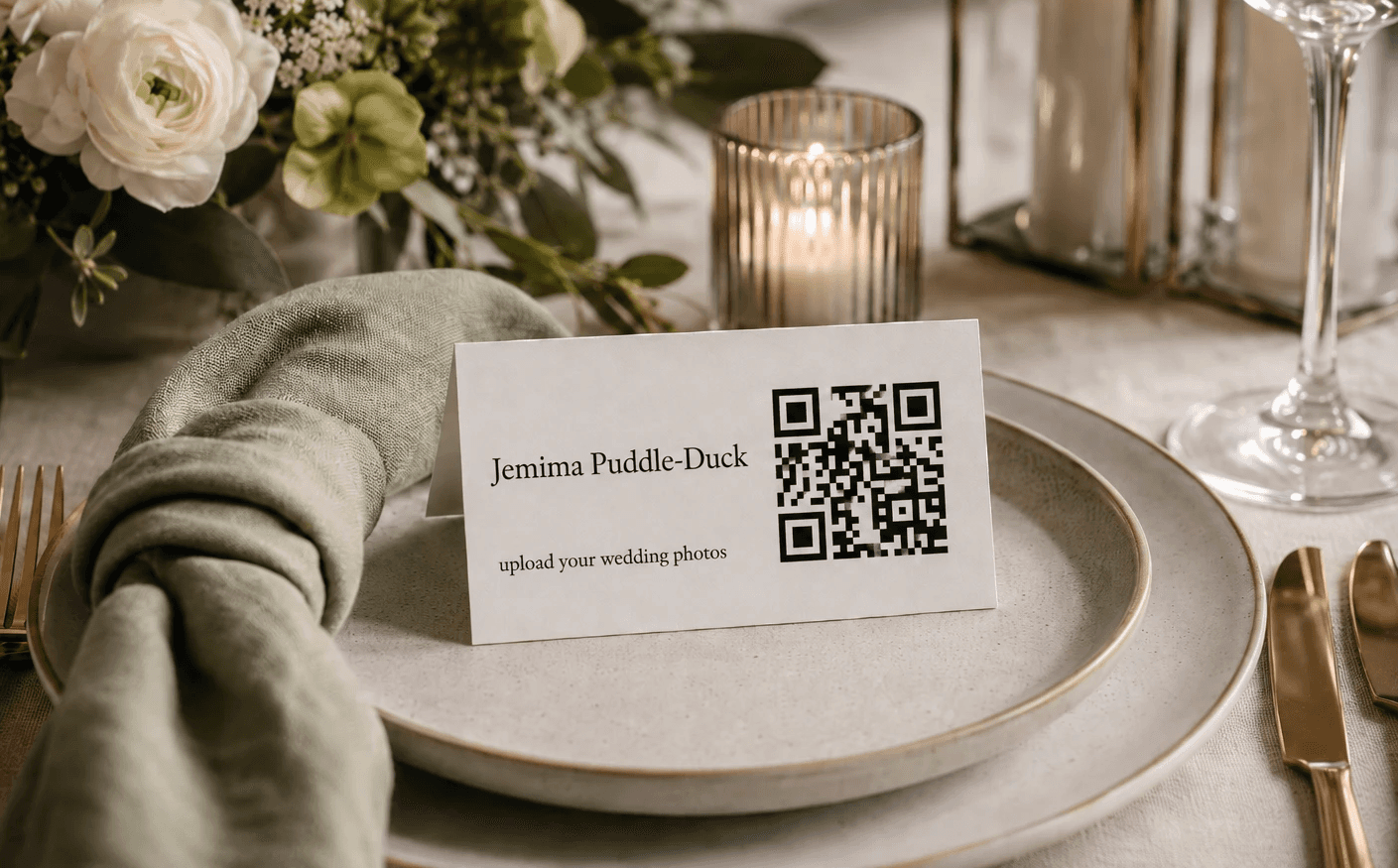
The Best Places to Put a Wedding Photo QR Code (Yes, Including the Toilets)
What alby Is, and Why Your Group Chat Isn't Cutting It